I've been using these since Suzuka and I am noticing a fair bit of vibration under heavy braking in the beginning stages of all my time attacks.
The pads are very good however they need to be heated up gradually in the first 3-5 laps by applying steady pressure to the pedal of no more than 70%. This will heat them up to the point where the vibration will not occur. Just a characteristic of this pad.
Thought I'd mention that since a lot of you have been emailing me about Project Mu's recently.

Friday, May 28, 2010

Thursday, May 27, 2010
Tuning Day at Fuji
Here are some photos from a tuning day I attended at Fuji Speedway earlier this month.


Wednesday, May 26, 2010
Much cooler now - Part 2 !
So how did the KOYO radiator rate on a Formula 1 class circuit ?
Before I answer this question, here is some background of what 'used to' happen...
Fuji Speedway on a day of about 25°C is what I consider a warm-to-hot track day especially if it is a clear sky kinda day. Water temperature during time attack would be usually around 95°C whilst the oil temperature would constantly exceed the 'safe' limit of 130°C. It was virtually impossible to do more than 2-3 hot laps without exceeding 130°C ! It was a real pain in the as%!
Which brings me to what the situation is like 'now', with the new radiator.
Firstly, water temperature never exceeds 85°C !! In fact 75°C-80°Cs is the norm! That's a 10°C improvement (!!) and right in the sweet spot of what this K20A engine likes (there is a small downside to this though...a cooling fan starts kicking in from 80°C and so this also means a little more power drain right when you're trying to push for the best lap)
Moving on to oil temperatures! I have a warning set at 128°C (I use MOTUL 300V oil, other oils would obviously have a much lower limit) which buzzes like silly when I exceed this temperature. Really annoying ! Needles to say, now I don't hear the buzz anymore ! In fact temperature only gets as high as 125°C or below ! Who needs an oil cooler right !?
I am absolutely stoked about this and I can finally have 5+ constant hot laps without needing to worry about oil or water overheating and all that on a warm-to-hot summer day ! I can only imagine how much lower the oil temps will be in the midst of winter (when it really counts !)
Do yourself a favour ! Upgrade your radiator if you track your car ! No buts about it !
Big thanks to Ryo from SEEKER for his valuable advice and attention to this car ! He really sets high standards for service in this tuning industry !
Rod
Before I answer this question, here is some background of what 'used to' happen...
Fuji Speedway on a day of about 25°C is what I consider a warm-to-hot track day especially if it is a clear sky kinda day. Water temperature during time attack would be usually around 95°C whilst the oil temperature would constantly exceed the 'safe' limit of 130°C. It was virtually impossible to do more than 2-3 hot laps without exceeding 130°C ! It was a real pain in the as%!
Which brings me to what the situation is like 'now', with the new radiator.
Firstly, water temperature never exceeds 85°C !! In fact 75°C-80°Cs is the norm! That's a 10°C improvement (!!) and right in the sweet spot of what this K20A engine likes (there is a small downside to this though...a cooling fan starts kicking in from 80°C and so this also means a little more power drain right when you're trying to push for the best lap)
Moving on to oil temperatures! I have a warning set at 128°C (I use MOTUL 300V oil, other oils would obviously have a much lower limit) which buzzes like silly when I exceed this temperature. Really annoying ! Needles to say, now I don't hear the buzz anymore ! In fact temperature only gets as high as 125°C or below ! Who needs an oil cooler right !?
I am absolutely stoked about this and I can finally have 5+ constant hot laps without needing to worry about oil or water overheating and all that on a warm-to-hot summer day ! I can only imagine how much lower the oil temps will be in the midst of winter (when it really counts !)
Do yourself a favour ! Upgrade your radiator if you track your car ! No buts about it !
Big thanks to Ryo from SEEKER for his valuable advice and attention to this car ! He really sets high standards for service in this tuning industry !
Rod
Sunday, May 23, 2010
Much cooler now !
This is perhaps not the most necessary upgrade one would embark on and many of you will probably only undertake such an upgrade much later on in your "tuning careers" but for me the time is now ! A brand new KOYO racing radiator !
(click on images below to enlarge them)

It is a KOYO Type-M racing aluminium radiator with a 36mm core consisting of 2 layers made specifically to an exact fit for a DC5. The OEM radiator was a DENSO 10mm single layer which just wasn't enough! Makes you wonder why a Type-R (and all Hondas actually) would have such a thin radiator but the answer isn't so difficult to come up with ... if Honda had given us all the best tuning parts in the world/Japan the car would have cost almost double of its original price. So they compromised.
To supplement this radiator I also ordered a SPOON low temperature thermostat and a fan switch to aid in cooling of this new system and some SAMCO radiator hoses.


As always the guys at SEEKER did the whole installation.
Bumper is off, coolant is being drained..

Some places are tough to get to !
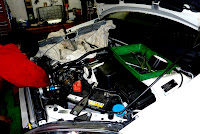
New radiator fully unpacked ...

Old radiator is out !

Look how thin the old radiator is !

1cm to be precise !

New thermostat is somewhere in there with the shiny blue hoses

KOYO radiator is in !

Time to bolt up what was unbolted ...

New coolant goes in ...

Pressurizing the system ...

All looking good !

These are brighter than I thought they'd be !

The intake cover goes back on ...

Getting the engine working so we can check all the components ...

Last look at it before it disappears behind the front bumper housing

And we're done !

So let's talk about the differences !
With the OEM radiator, water temperatures during city driving ranged anywhere between 82C - 100C (average in low-mid 90s) depending on weather / traffic conditions. The cooling fan usually kicked in around 93C-97C if the car was stationary for longer than usual. High speed highway and circuit driving would yield around 85C-90C.
With the KOYO radiator (and this is a pleasant surprise !), city driving range seems to be between 78C-85C (average of 80C) and the fan kicks in around 80C. So far I have been only able to do high speed highway driving and the temperature stayed at a constant of 75C !!! To add to this the oil temperature stayed below 90C whereas with the OEM radiator it was 95C-ish.
So there is no doubt cooling is now greatly improved and finally I can relax about the engine heating up too much, hopefully my next circuit visit confirms that the oil temperatures are now also under control and thirdly this K20A engine can now work at its optimum performance with such a well cooled system.
(click on images below to enlarge them)

It is a KOYO Type-M racing aluminium radiator with a 36mm core consisting of 2 layers made specifically to an exact fit for a DC5. The OEM radiator was a DENSO 10mm single layer which just wasn't enough! Makes you wonder why a Type-R (and all Hondas actually) would have such a thin radiator but the answer isn't so difficult to come up with ... if Honda had given us all the best tuning parts in the world/Japan the car would have cost almost double of its original price. So they compromised.
To supplement this radiator I also ordered a SPOON low temperature thermostat and a fan switch to aid in cooling of this new system and some SAMCO radiator hoses.


As always the guys at SEEKER did the whole installation.
Bumper is off, coolant is being drained..

Some places are tough to get to !

New radiator fully unpacked ...

Old radiator is out !

Look how thin the old radiator is !

1cm to be precise !

New thermostat is somewhere in there with the shiny blue hoses

KOYO radiator is in !

Time to bolt up what was unbolted ...

New coolant goes in ...
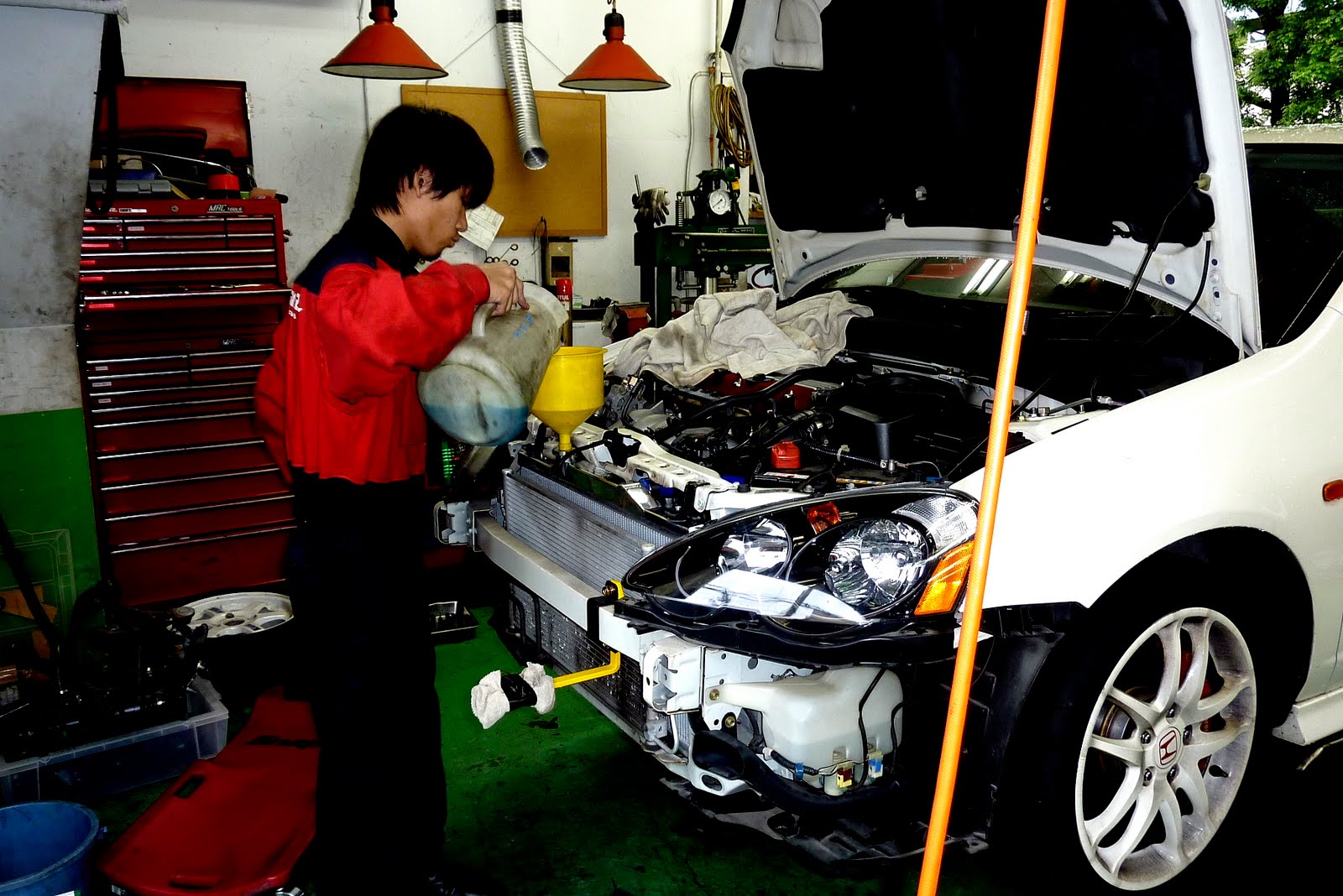
Pressurizing the system ...

All looking good !

These are brighter than I thought they'd be !

The intake cover goes back on ...

Getting the engine working so we can check all the components ...

Last look at it before it disappears behind the front bumper housing

And we're done !

So let's talk about the differences !
With the OEM radiator, water temperatures during city driving ranged anywhere between 82C - 100C (average in low-mid 90s) depending on weather / traffic conditions. The cooling fan usually kicked in around 93C-97C if the car was stationary for longer than usual. High speed highway and circuit driving would yield around 85C-90C.
With the KOYO radiator (and this is a pleasant surprise !), city driving range seems to be between 78C-85C (average of 80C) and the fan kicks in around 80C. So far I have been only able to do high speed highway driving and the temperature stayed at a constant of 75C !!! To add to this the oil temperature stayed below 90C whereas with the OEM radiator it was 95C-ish.
So there is no doubt cooling is now greatly improved and finally I can relax about the engine heating up too much, hopefully my next circuit visit confirms that the oil temperatures are now also under control and thirdly this K20A engine can now work at its optimum performance with such a well cooled system.
Saturday, May 22, 2010

Subscribe to:
Posts (Atom)